


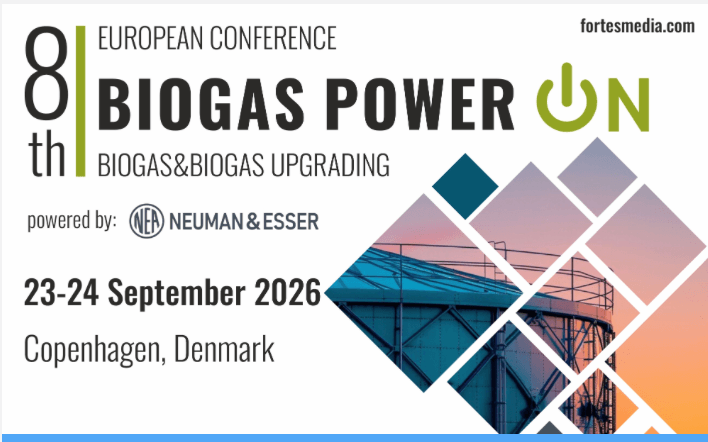
8th European Conference Biogas PowerON 2026
September 23 - September 24
DETAILS
Following last year’s great response to our Biogas PowerON 2025 with over 120 participants from 22+ countries we’re announcing next edition, 8th European Conference Biogas PowerON 2026, with great excitement. The conference will take place on 23-24 September 2026 in Copenhagen, Denmark. Our 2026 edition focuses on excellent speakers with highly searched presentations, industry panel discussion, technical insights and many hours of networking.
The global biogas market in 2025 is witnessing significant growth, driven by the increasing demand for renewable energy and government policies promoting sustainability. Technological advancements in biogas production, particularly in anaerobic digestion, are improving efficiency and reducing costs. Biogas plays a crucial role in reducing greenhouse gas emissions, contributing to both energy security and waste management solutions.
Key drivers of growth include government incentives, rising clean fuel demand, and biogas’ potential in the transportation sector. Europe, North America, and emerging markets in Asia-Pacific are expected to lead the way in production and adoption. By 2030, global biogas production is projected to increase substantially, with Europe aiming to produce 35 bcm annually. The role of biogas in achieving net-zero emissions targets and supporting sustainable infrastructure is becoming more important.
Site visit – 22nd September
The day before the main event, on 22nd September 2026, a limited number of conference participants will have a unique opportunity to visit Jordberga biogas plant during an exclusive site visit. The tour is organized thanks to Gasum.
Register your interest in the site visit when booking your ticket. Participation is free of charge, and spaces are allocated on a first-come, first-served basis.
To sign up, please add “I would like to join the site visit” in the “More Information” section during registration.
The biogas plant was built in 2013–2014 and has been operated by Gasum since 2017. The facility produces around 110 GWh of biomethane annually and generates approximately 120,000 tonnes of biofertilizer, contributing to a CO₂ reduction of about 28,000 tonnes per year. Originally designed to process mainly vegetable-based crops, the plant now runs on approximately 80% residual and secondary products.
The facility operates three parallel digestion lines, each with separate feeding systems and two-stage digesters. Raw biogas is upgraded using water scrubbing technology, and the produced biomethane is injected into the local gas grid, with surplus volumes transferred to the national gas network.